


.png)
.png)
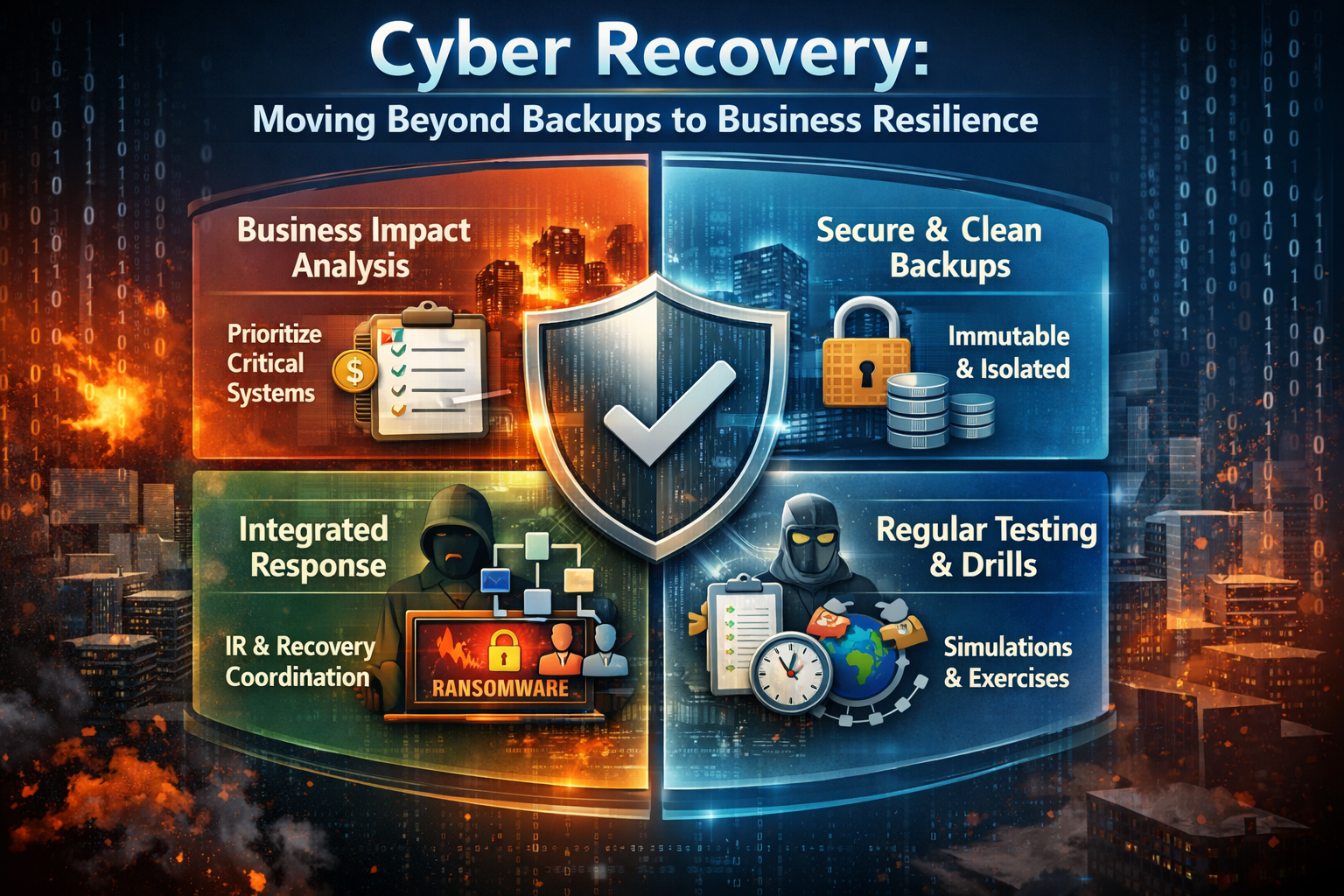
Cyber Recovery: Moving Beyond Backups to Business Resilience
Cyberattacks are no longer hypothetical events; they are expected operational risks. Ransomware, destructive malware, insider threats, and supply chain compromise have made traditional disaster recovery strategies insufficient. Backups alone do not equal recovery, and recovery does not automatically equal business continuity.
Cyber recovery is the discipline of restoring trusted operations after a cyber incident (quickly, safely, and in a way that prioritizes the business). Organizations that succeed treat cyber recovery as a business capability, not just a technology investment.
A mature cyber recovery strategy stands on four pillars.
#1. Business Impact Drives Prioritization
The foundation of cyber recovery is understanding what matters most to the business, not what is easiest to recover. Too many recovery plans are infrastructure-centric, focusing on storage systems, virtual machines, or cloud subscriptions. When a real incident occurs, teams struggle to answer basic questions regarding which applications must come back first and what level of data loss is actually tolerable.
Key Strategy: Business Impact Analysis (BIA)
- Identify Tier 0 and Tier 1 applications that directly impact revenue, safety, or regulatory obligations
- Define RTO and RPO at the application level rather than the platform level
- Map dependencies including databases, identity, DNS, and third-party APIs
Without this clarity, organizations often recover dozens of low-value systems while mission-critical applications remain unavailable.
#2. Technology Selection for Clean Restoration
Once priorities are clear, technology choices must support clean, trusted restoration rather than just fast restores. A modern cyber recovery architecture should include:
- Immutable backups to prevent deletion or encryption by attackers
- Isolated storage (air-gapped or logical) to reduce the blast radius
- Clean rooms where systems can be validated safely before re-entry
- Integrity validation to ensure malware is not restored into production
Technology selection should be driven by recovery outcomes rather than brand loyalty. Recovery that depends on compromised credentials or infected directories is not recovery; it is reinfection.
#3. Integrated Recovery and Incident Response
Cyber recovery does not exist in isolation. It must be tightly integrated with the Incident Response (IR) plan to form a single, coordinated operating model. This requires:
- Unified process flows: moving from detection and containment to validation and return to service
- Documented RACI: defining who has the authority to declare systems "clean" or approve data loss
- Communication plans: established paths for legal, PR, regulators, and partners
Many organizations document technical procedures but fail to define decision authority. A strong cyber recovery plan removes this ambiguity, preventing delays caused by uncertainty under pressure.
#4. Frequent and Inclusive Testing
A plan that has not been tested is a plan that does not exist. Cyber recovery requires rigorous, continuous testing rather than annual compliance exercises. This process must go far beyond IT infrastructure teams to include:
- Technical Drills to validate restore speed and dependency sequencing
- Tabletop exercises simulating ransomware and data theft
- Cross-functional simulations involving legal, HR, and executive leadership
Application owners must participate because they are often the only ones who can confirm if recovered data can be trusted. Organizations that treat testing as an audit checkbox often discover critical gaps only when time and options are limited.
Common (and Often Fatal) Dependencies
Even well-architected recovery strategies fail due to overlooked "gotchas." These components must be planned and tested independently:
- Identity Providers (IDP): If Active Directory or IAM platforms are compromised, your recovery tooling may be unusable.
- DNS Services: Recovery environments often come up "healthy" but remain inaccessible due to missing or poisoned DNS records.
- Network Segmentation: Firewalls and routing policies may not automatically adapt to a recovery environment.
- Encryption Keys: If your Key Management System (KMS) is inaccessible, your data remains irrecoverable despite a successful technical restore.
- Third-Party APIs: Applications often depend on external licensing or cloud services that behave differently during isolation.
A Business Discipline
The question is no longer if an incident will occur, but whether the organization can restore trusted operations before material damage is done. Cyber recovery is a business resilience discipline owned jointly by IT, security, and leadership. Those who invest early in prioritization and testing will recover faster and protect what matters most.
We’re happy to dive deeper with your organization. You can contact our team here to get started.